
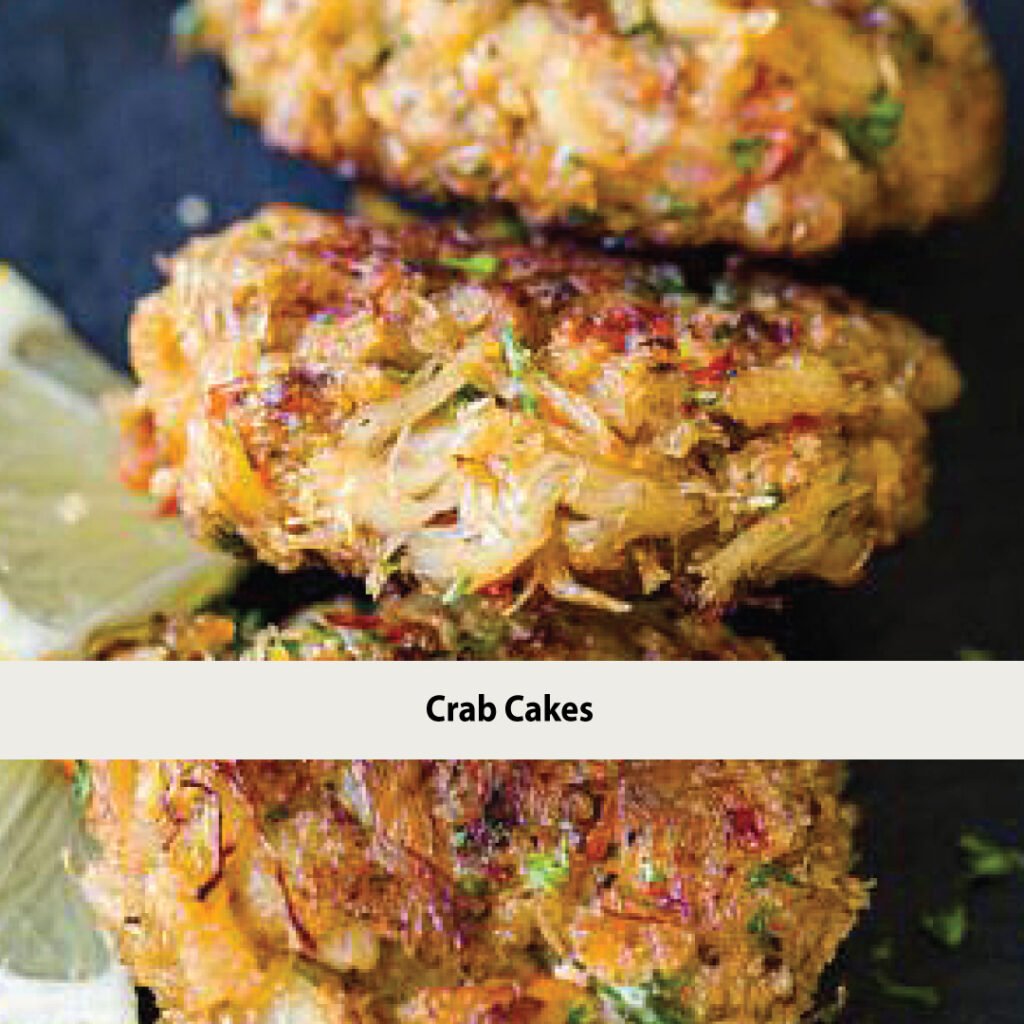
Crab cakes
Crab cakes are golden, crispy patties made with sweet, tender crab meat blended with herbs, light seasoning, and just enough binder to hold them together. Delicately crisp on the outside and soft and flavorful inside, they’re a seafood classic perfect as an appetizer or elegant main dish.
In a professional kitchen, a crab cake is a test of restraint. Most amateur recipes are essentially “bread cakes with a hint of crab.” A chef’s goal is to create a structural miracle: a patty that is 90% lump crab meat and just enough “binder” to keep it from falling apart before it hits your tongue.
This recipe is the “Gold Standard” Coastal Crab Cake. We use a “minimalist emulsion” technique that prioritizes the sweet, delicate flavor of the crustacean over the heaviness of flour or fillers.
Recipe Overview: The “Lump-First” Crab Cake
- Prep time: 20 minutes (plus 30 minutes chilling)
- Cook time: 8–10 minutes
- Servings: 6 Large Cakes (or 12 appetizer-sized)
- Chef’s Difficulty: 4/10 (The challenge is in the gentle folding)
What This Recipe Is
An authentic, high-end Maryland-style crab cake featuring Jumbo Lump crab meat bound by a light Dijon-mayonnaise custard and seasoned with classic coastal aromatics.
The Ingredients
The Star (The Meat)
- 1 lb Jumbo Lump Crab Meat: (Fresh is non-negotiable. Look for “Hand-Picked” to ensure quality).
The “Binder” (The Custard)
- 1 Large Egg: Lightly beaten.
- ¼ cup High-Quality Mayonnaise: (I recommend Duke’s or Hellmann’s for the correct fat-to-acid ratio).
- 1 tsp Dijon Mustard: For a sharp “kick.”
- 1 tsp Worcestershire Sauce: For deep umami.
- 1 tsp Old Bay Seasoning: The quintessential coastal spice.
- 1 tbsp Fresh Italian Parsley: Finely minced.
- 2 tsp Fresh Lemon Juice.
- ½ cup Saltine Crackers: Crushed into fine dust (approx. 10–12 crackers).
The Sear
- 2 tbsp Unsalted Butter.
- 1 tbsp Neutral Oil: (Grapeseed or Avocado oil for a high smoke point).
The Chef’s Instructions
- The Inspection: Spread the crab meat out on a flat baking sheet. Very gently, run your fingers through it to check for any stray shells or cartilage. Chef’s Rule: Do not “stir” the crab; you want to keep those large “lumps” intact.
- The Custard: In a separate medium bowl, whisk together the egg, mayo, mustard, Worcestershire, Old Bay, parsley, and lemon juice until completely smooth.
- The Marriage: Pour the custard over the crab meat. Add the crushed saltines. Use a rubber spatula to fold the mixture. Think of it like folding egg whites into a soufflé—gentle, sweeping motions.
- The “Set” (Crucial): Form the mixture into 6 mounds. Do not pack them tightly; they should just hold their shape. Place on a parchment-lined tray, cover loosely, and refrigerate for at least 30 minutes. This allows the cracker meal to hydrate and the proteins to “bond,” ensuring they don’t fall apart in the pan.
- The Sear: Heat the oil and butter in a heavy stainless steel or cast-iron skillet over medium-high heat. When the butter foams, carefully add the cakes.
- The Golden Rule: Cook for 4–5 minutes per side. Do not move them until a brown crust has formed. Flip once, gently, using a wide metal spatula.
- The Finish: Once the internal temperature reaches 155°F (they will carry over to 160°F), remove them and rest for 2 minutes on a wire rack (not a paper towel, which makes them soggy).
Nutritional Overview (Per Cake)
- Calories: 240 kcal
- Protein: 18g
- Fat: 16g
- Carbs: 7g
Why This Recipe Is Special
In a professional kitchen, we differentiate between “filler-heavy” pub food and “estate-level” gastronomy. Most home recipes for crab cakes act as a breading vehicle, but this specific method is a structural marvel that treats the crab as the primary architect of the dish.
Here is exactly why this recipe stands apart from the standard culinary landscape:
1. The “Zero-Flour” Structural Integrity
Standard recipes often use flour or heavy breadcrumbs to ensure the cake doesn’t fall apart. This recipe uses crushed Saltine crackers. Why? Because Saltines contain a specific type of yeast and high-protein flour that, when combined with the egg-mayo custard, “melts” into the meat. It provides a chemical bond rather than a physical one, allowing the cake to stay together while feeling like it contains zero filler.+1
2. Preservation of the “Jumbo Lump” Anatomy
In high-end seafood houses, we pay a premium for “Jumbo Lump” meat because of the long, sweet muscle fibers. Most recipes instruct you to mix ingredients in a way that shreds these lumps. This recipe utilizes a “Folding” technique borrowed from pastry chefs making soufflés. By folding the binder around the crab rather than into it, you maintain large, succulent “bursts” of crab meat in every bite.
3. The Lactic Acid-Fat Balance
The “binder” in this recipe isn’t just a glue; it’s a flavor balancer. We use a specific ratio of Dijon mustard and lemon juice (acid) to cut through the mayonnaise and butter (fat). This creates a “bright” flavor profile that highlights the sweetness of the crab rather than masking it behind a heavy, greasy curtain.
4. The “Thermal Shock” Cold-Set
This recipe insists on a 30-minute mandatory chill. This is a professional secret. The cold temperature allows the cracker meal to fully “hydrate” and the proteins in the egg to “tighten.” When that ice-cold cake hits the hot buttered skillet, the exterior sears instantly into a protective shell, while the interior remains steaming and moist.
5. The “Minimalist” Spice Profile
Instead of a cabinet’s worth of spices, we rely on Old Bay and Worcestershire sauce. This is “Coastal Wisdom.” These two ingredients contain celery salt, paprika, and fermented anchovy—the exact molecular components needed to amplify the natural “ocean” flavor of the crab without making it taste like a spice rack.
The Chef’s Perspective
This recipe is special because it respects the ingredient. When you’re spending a premium on fresh, hand-picked crab, the recipe’s job is to stay out of the way. This method provides just enough “background noise” to make the crab sing, resulting in a cake that feels luxurious, light, and incredibly expensive.
Why You’ll Love It
In a professional kitchen, we measure the success of a dish by its “craveability”—that specific intersection of texture, temperature, and psychological satisfaction. This crab cake isn’t just a meal; it’s an experience designed to hit every sensory trigger.
Here is why this recipe will become your new gold standard:
1. The “Cloud-Like” Texture
Most people expect a crab cake to be somewhat dense or “cakey” (hence the name). You will love this version because it defies that expectation. Because we use a custard-based binder rather than a dough-based one, the interior feels almost like a savory mousse. It’s airy, light, and melts on the tongue, providing a luxurious mouthfeel that you usually only find in high-end steakhouses.
2. The “Snap” of the Golden Crust
There is a profound joy in the first bite of a perfectly seared cake. By using a combination of butter (for flavor) and oil (for heat), we achieve a uniform, mahogany-colored crust. You’ll love the audible “crunch” as your fork breaks through the exterior, immediately followed by the release of steam and the aroma of toasted spices and sweet seafood.
3. No “Fishy” Aftertaste
Many amateur seafood dishes can be overwhelming. Because this recipe uses a precise balance of citrus (lemon juice) and vinegar (mustard/Worcestershire), it “washes” the palate. You’ll love that it tastes clean, bright, and sweet—highlighting the fresh, briny essence of the ocean without any of the heavy, oily “fishiness” associated with lesser quality cakes.
4. Culinary Confidence (The “No-Fail” Factor)
There is nothing more stressful than a crab cake falling apart in the pan. You’ll love this recipe because the “Cold-Set” technique makes you look like a pro. Even if you aren’t an expert at the stove, the science behind the hydrated cracker meal ensures the cakes stay perfectly circular and structurally sound, giving you a massive boost of confidence when serving guests.
5. The “Jumbo Lump” Reward
There is a specific visual and textural satisfaction in seeing actual, recognizable chunks of crab meat. You’ll love that this isn’t a “mystery patty.” When you pull a piece away, you see the long, white muscle fibers of the crab. It feels—and is—indulgent, making every bite feel like a special occasion.
6. Effortless Elegance
Finally, you’ll love the ratios. This recipe does the heavy lifting for you. You don’t need a complicated array of side dishes; the crab cake is so flavorful and structurally complete that a simple wedge of lemon and a sprig of parsley are all you need to make the plate look like it cost $50 at a coastal bistro.
Tools You’ll Need
In a professional kitchen, we say “the tools are the hands of the chef.” For crab cakes, your equipment needs to be as delicate as the meat itself. Because we are working with expensive Jumbo Lump crab, you cannot afford to have a spatula that tears the meat or a pan that creates “hot spots” and burns the butter.
Here is the professional toolkit required to execute these perfectly:
1. Large Rimmed Baking Sheet
- The Purpose: This is for the “Initial Inspection.” You never dump crab meat straight from the container into a bowl.
- The Chef’s Detail: Spreading the crab onto a wide, flat baking sheet allows you to see every single piece of meat. This makes it infinitely easier to find stray shells or cartilage without over-handling the meat and breaking the lumps.
2. Non-Reactive Mixing Bowls (Glass or Stainless Steel)
- The Purpose: To whisk the “Custard Binder.”
- The Chef’s Detail: You want a bowl that is “non-reactive.” Avoid aluminum, as the lemon juice and mustard can react with the metal, giving your delicate crab a subtle (and unwanted) metallic tang. Use a medium bowl for the custard and a large one for the final “marriage” of ingredients.
3. Large Rubber or Silicone Spatula
- The Purpose: For the “The Fold.”
- The Chef’s Detail: A stiff metal spoon will act like a knife and chop up your beautiful crab lumps. A wide, flexible silicone spatula allows you to scrape the bottom of the bowl and fold the binder over the crab in a sweeping motion, preserving the anatomy of the meat.
4. 4-oz Stainless Steel Portion Scoop (Ice Cream Scoop)
- The Purpose: Uniformity and “Gentle Handling.”
- The Chef’s Detail: Using your hands to form cakes can lead to “over-packing,” which makes the cakes dense and tough. A spring-loaded scoop ensures every cake is the exact same size (so they cook at the same rate) and drops the meat onto the tray without compressing it.
5. Heavy-Bottomed Skillet (Cast Iron or 3-Ply Stainless Steel)
- The Purpose: Heat Retention and the “Golden Crust.”
- The Chef’s Detail: Thin pans have “hot spots” that will burn the butter before the center of the crab cake is hot. A heavy-bottomed pan distributes heat evenly. Cast iron is excellent for a rustic, heavy sear, while a high-quality stainless steel pan allows you to see the color of the “fond” (the brown bits) more clearly.
6. Offset Fish Turner (The “Flexible” Spatula)
- The Purpose: The delicate flip.
- The Chef’s Detail: A standard, thick plastic spatula is too blunt. A Fish Turner is made of thin, flexible spring steel with wide slots. It can slide effortlessly under a fragile crab cake without breaking the crust, and the slots allow excess butter to drain away as you move the cake.
7. Wire Cooling Rack (Set over a tray)
- The Purpose: Moisture Management.
- The Chef’s Detail: If you put a hot, seared crab cake onto a flat plate or a paper towel, the steam from the bottom will get trapped, turning your crispy crust soggy within 60 seconds. Resting the cakes on a wire rack allows air to circulate underneath, keeping the base as crisp as the top.
8. Instant-Read Digital Thermometer
- The Purpose: Precision.
- The Chef’s Detail: Crab is pre-cooked, but the egg in the binder is not. You are looking for an internal temperature of 155°F. Guessing leads to dry crab. A digital probe allows you to pull the cakes the second they hit the safety mark.
The “Chef’s Station” Setup
Before you start cooking, arrange your tools in a “Linear Flow”:
- Tray of chilled cakes on the left.
- The Skillet on the burner.
- The Fish Turner is next to the stove.
- The Wire Rack on the right is for the finished product.
Pro Tips
In a professional kitchen, we differentiate between a “recipe” and a “technique.” The recipe tells you what to buy, but the technique—the Pro Tips—is what determines if that expensive crab meat turns into a masterpiece or a disappointment.
Here are the industry secrets to achieving the perfect, restaurant-grade crab cake:
1. The “Paper Towel” Pre-Drain
Crab meat is often packed in a light brine. Even “dry-packed” crab has residual moisture.
- The Pro Move: Once you’ve checked for shells on your baking sheet, gently lay a second paper towel over the crab and press very lightly.
- Why it works: Removing that excess moisture prevents the “custard” binder from becoming watery. A drier mix leads to a tighter bond and a much better sear.
2. The “Saltine Dust” Ratio
Don’t just crumble the crackers; you want a variety of textures.
- The Pro Move: Pulse the saltines until 70% are fine dust and 30% are small, pea-sized crumbs.
- Why it works: The “dust” dissolves into the binder to create the structural glue, while the tiny crumbs provide internal “pockets” of texture that keep the cake from feeling like a dense paste.
3. The “Cold-Bond” Mandatory Rest
This is the most skipped step in home kitchens and the most important one in professional ones.
- The Pro Move: Chill the formed cakes for at least 30 to 60 minutes before they touch the pan.
- Why it works: This is called “hydration.” It gives the cracker meal time to absorb the moisture from the egg and mayo. It turns a fragile pile of crab into a cohesive patty that won’t shatter when you flip it.
4. Use “Clarified” Butter or a Butter-Oil Blend
Regular butter has milk solids that burn at low temperatures (the “black speck” problem).
- The Pro Move: Use a 50/50 mix of Neutral Oil (Grapeseed) and Unsalted Butter.
- Why it works: The oil raises the “smoke point,” allowing you to get a high-heat sear, while the butter provides that essential nutty flavor and golden color.
5. The “No-Touch” Searing Rule
Amateur cooks tend to move the food around to “check” it.
- The Pro Move: Place the cake in the hot fat and do not touch it for at least 4 minutes.
- Why it works: You are waiting for the “Maillard reaction”—the chemical bridge that creates the crust. If you move it too early, you break the protein bonds, and the cake will stick to the pan and tear.
6. The “Carry-Over” Cooking Strategy
Crab is delicate; if it hits 165°F in the pan, it will be dry by the time it hits the table.
- The Pro Move: Pull the crab cakes off the heat when the internal temperature hits 150°F–155°F.
- Why it works: “Carry-over cooking” will continue to raise the internal temp by another 5–10 degrees while the cake rests on the wire rack. This ensures the egg is safe but the crab remains juicy.
7. The “Vibratory” Portioning
If you don’t have a scoop, use two large spoons.
- The Pro Move: Scoop the meat with one spoon and gently “roll” it onto the other.
- Why it works: This keeps the “air” inside the cake. A compressed crab cake is a tough crab cake. You want the interior to be “fluffy.”
8. Season the “Exterior,” Not Just the “Interior.”
Most people put the Old Bay in the mix and forget the crust.
- The Pro Move: Right before the cakes go into the pan, hit the top and bottom with a micro-dusting of Old Bay and a tiny pinch of salt.
- Why it works: This seasons the crust directly, hitting the tongue first and amplifying the “coastal” experience.
The “Executive Chef” Final Touch
When you plate the crab cake, never pour sauce over it. Place a “pool” of sauce on the plate and set the cake on top, or serve it on the side. This preserves the integrity of that hard-earned crispy crust you just spent 10 minutes perfecting.
Mistakes to Avoid
In a professional kitchen, we treat crab cakes with respect—one wrong move turns $40 of Jumbo Lump into mush. Here is the “Short List” of critical mistakes to avoid:
The “Chef’s Short List” of Failures
To keep your crab cakes from getting boring, use the “Mother Recipe” structure but swap the flavor profiles. Here are the professional twists in short:
The “Chef’s Twist” Short List
- The “Thai-Coast”: Swap Old Bay for Red Curry Paste, lemongrass, and cilantro. Use coconut cream in the binder and serve with sweet chili sauce.
- The “Crab Imperial”: Top the cake with a mix of mayo, egg yolk, and lemon, then broil it for a decadent, soufflé-like cap.
- The “Everything Bagel” Crust: Dredge the exterior in Everything Bagel Seasoning before searing for a savory, smoky crunch.
- The “Southern Benedict”: Use the cake as the base for a poached egg and Old Bay Hollandaise for the ultimate luxury brunch.
- The “Mediterranean”: Swap saltines for Panko and oregano, fold in Feta crumbles, and serve with Tzatziki.
- The “Shrimp Hybrid”: Mix in 20% minced cold-water shrimp. They act as a “natural binder” and give the cake a firmer, snappier bite.
New Shapes
- Poppers: 1-inch spheres for high-end “street food” appetizers.
- Stuffed Portobello: Mound the mix into mushroom caps and bake for maximum moisture.
- Lollipops: Form around skewers for elegant, mess-free party service.
Summary: If it’s soggy or shredded, you likely over-mixed it or under-heated the pan. Respect the lump, chill the dough, and sear it hot.
Variations & Creative Twists
To keep your crab cakes from getting boring, use the “Mother Recipe” structure but swap the flavor profiles. Here are the professional twists in short:
The “Chef’s Twist” Short List
- The “Thai-Coast”: Swap Old Bay for Red Curry Paste, lemongrass, and cilantro. Use coconut cream in the binder and serve with sweet chili sauce.
- The “Crab Imperial”: Top the cake with a mix of mayo, egg yolk, and lemon, then broil it for a decadent, soufflé-like cap.
- The “Everything Bagel” Crust: Dredge the exterior in Everything Bagel Seasoning before searing for a savory, smoky crunch.
- The “Southern Benedict”: Use the cake as the base for a poached egg and Old Bay Hollandaise for the ultimate luxury brunch.
- The “Mediterranean”: Swap saltines for Panko and oregano, fold in Feta crumbles, and serve with Tzatziki.
- The “Shrimp Hybrid”: Mix in 20% minced cold-water shrimp. They act as a “natural binder” and give the cake a firmer, snappier bite.
New Shapes
- Poppers: 1-inch spheres for high-end “street food” appetizers.
- Stuffed Portobello: Mound the mix into mushroom caps and bake for maximum moisture.
- Lollipops: Form around skewers for elegant, mess-free party service.